Тавлеи против людей.

Artist: Copyright © Rasmus Holbroe (Jan. 2016).
World Tafl Federation Championship 2026 - Sign Up from July 1!The annual World Tafl Federation Championship is back!This year's tournaments include Copenhagen Hnefatafl, Historical Hnefatafl, and Race Games. Test your skills against players from around the world and fight for the championship titles! Sign-up opens on July 1, 2026. Deadline for registration: August 31, 2026. Full tournament details here: Tournament Page 2026. We look forward to seeing you in the tournament! |
|
Play against humans. Тавлеи против людей.
Artist: Copyright © Rasmus Holbroe (Jan. 2016). |
|
2026-08-31 21:47 Hagbard: Registered by August 31: Historical: Alex Hnefatafl, Ailill, gulo, Hagbard, Tonythebook, Pavlo, Potapych, Dimetr, Draganov, MasterLuke, saxon, Zugwykor, Paul7, LuckyScoundrel, Finneon7, brave-frog, Casshern, Askeladd If the tournament were to start now, the setup would be: https://aagenielsen.dk/wtfturnering2026.php
https://aagenielsen.dk/wtfturnering2026.php 2026-08-31 20:01 Hagbard: Info: NB. Last year, I kept a very close eye on all approaching timeouts and warned players about them a total of 73 times. I won't have time to do that this year! So please keep a close eye on the game timing, e.g. here: https://aagenielsen.dk/wtftidsfrister.php
https://aagenielsen.dk/wtftidsfrister.php 2026-08-31 18:17 Hagbard: may Loki give you laughter as you go
2026-08-31 18:15 Hagbard: I'm here...
2026-08-31 16:50 Waclaw: Where did Hagbard disappear to?
2026-08-31 14:43 Hagbard: The Copenhagen tournament starts today at about 18 o'clock Danish time. Please check that you're on the list: 27 players: Alex Hnefatafl, Waclaw, Black Raven, Ailill, SuruRada, Jrton80, Tonythebook, Murray7, sqAree, Pavlo, Potapych, Hattusili, Fraech, Draganov, saxon, Paul7, Zinedine80, LuckyScoundrel, Luizz, cacreal, Askeladd, Finneon7, brave-frog, Fermillyc, Casshern, OdinHimself, Floki The tournament setup is shown here: https://aagenielsen.dk/wtfturnering2026.php
https://aagenielsen.dk/wtfturnering2026.php 2026-08-31 06:18 Fermillyc: Registers for the WTF Copenhagen Tournament.
2026-08-30 11:49 Floki: Registers for the WTF Copenhagen Tournament.
2026-08-30 10:58 Hagbard: The Copenhagen tournament starts tomorrow at about 18 o'clock Danish time. Please check that you're on the list: 27 players: Alex Hnefatafl, Waclaw, Black Raven, Ailill, SuruRada, Hagbard, Jrton80, Tonythebook, Murray7, sqAree, Pavlo, Potapych, Hattusili, Fraech, Draganov, saxon, Paul7, Zinedine80, LuckyScoundrel, Luizz, cacreal, Askeladd, Finneon7, brave-frog, fermillyc, Casshern, OdinHimself The tournament setup is shown here: https://aagenielsen.dk/wtfturnering2026.php Deadline for registering for the Copenhagen line: tomorrow at 12 o'clock Danish time.
https://aagenielsen.dk/wtfturnering2026.php 2026-08-30 08:43 OdinHimself: Registers for the WTF Copenhagen Tournament.
|

Alexander Steiger Dis' game set up in the Royal Hall in Lejre, Denmark. (Click on the image)
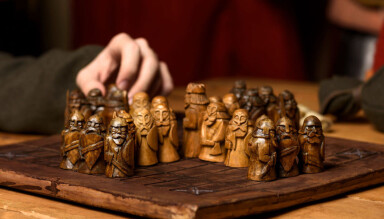
Train your brain like a viking. Science Days in Norway Sep. 27th 2020. (Click on the image!)
Hnefatafl is also known by the names Nefatavl, The King's Table, The Viking Game, Viking Chess, Tablut or simply Tafl.
History of this site.
Art on this site.
Comments on Hnefatafl.
The origin of the Viking board game Hnefatafl and the Berserk rules.
Links to more information about the Viking board game Hnefatafl.
Tafl Shops.
Viking word of wisdom: The Hávamál.
(Havámál på dansk).
| World Championship Tournament 2025. |
| Здесь можно играть в тавлеи против людей. Можно использовать кириллицу. |
| Many thanks to Tim Millar ("crust"), Adam Bartley ("Adam"), John C. Ashton, Nicolas Cartier, Jonas Lööf ("conanlibrarian"), Olli Salmi, Damian Walker ("cyningstan"), Rasmus Holbroe, Thore Nissen, Lucho Panchev ("OdinHimself"), Corey Hart ("Brench"), Alexander Steiger Dis ("Steiger"), Dmitry Pashkov, Delray Curtis ("jrton80"), David Zolli ("branan"), Luk Martens ("Masterluke"), Marian Luck ("themightyglider"), Mikkel Berg-Nordlie ("mihkkal"), Alessandro Arzani ("Abbas Agraphicus") and all players who contributed to this site and to the photo gallery. And not least the more than 600 players from all over the world who have played 65,000 real human-vs-human tafl games here, creating a vast body of practical experience with this intriguing historical board game. (And lately, AI - namely ChatGPT, Claude, and Gemini - has helped with some things.) |
|
Updated 19.8.2026
Copyright © 1998-2026 Aage Nielsen. All rights reserved. |

